





Blogs
Posted on 29 June, 2026
Compression Leggings Manufacturer: OEM & Private Label Services
Share On:



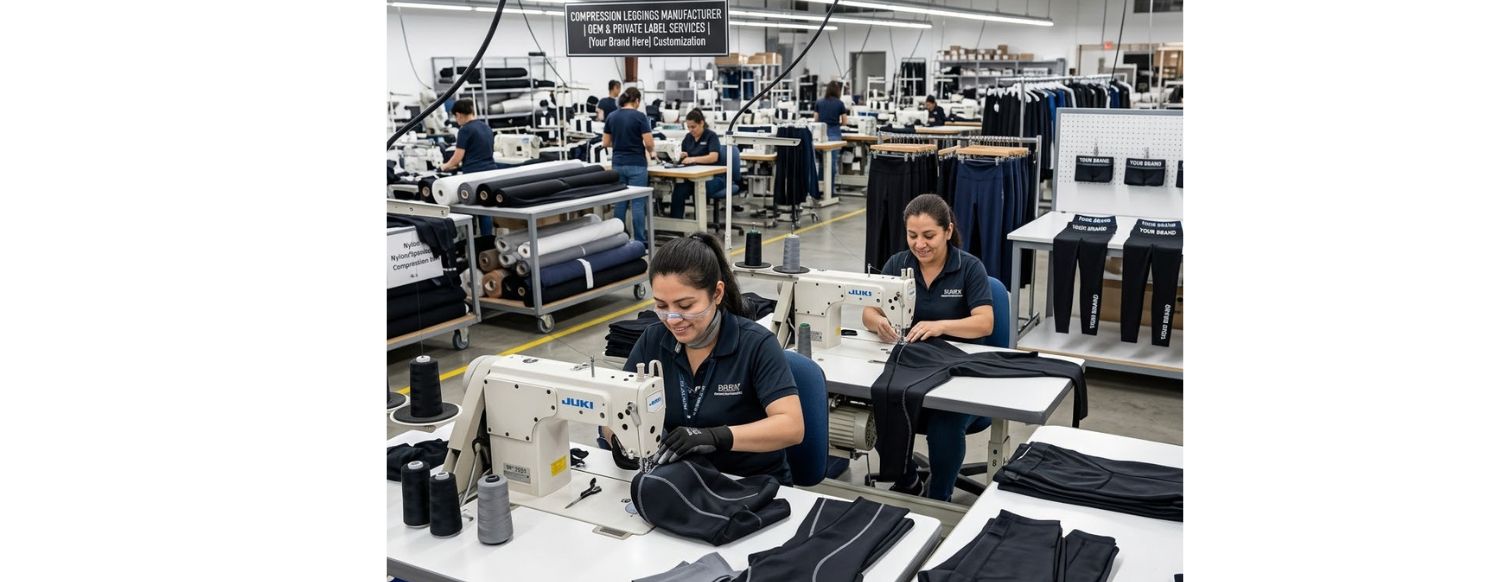
Have you ever put on a pair of compression leggings that felt great and fitted perfectly? They’re comfortable and fit perfectly. You'd expect that from a quality product. So who makes these quality leggings? It’s not by accident. Each successful pair of leggings has an expert manufacturing partner who knows about fabric tension, stitch accuracy, and the science of support for muscles. For any activewear company looking to expand into new product categories (including leggings), choosing the correct compression leggings manufacturing partner is hugely important for creating long-term customer loyalty. If you're thinking about starting or growing an activewear company, when shopping for the correct compression leggings manufacturer, you'll need to know how to evaluate potential partnerships using OEM and private-label definitions. Let's take a look at what these terms mean to you and your company as well as what criteria to use when evaluating potential partners.
What Are OEM and Private Label Services?
OEMs (Original Equipment Manufacturers) conduct the manufacturing of leggings using your unique specifications and branding requirements from the beginning. The customer provides the manufacturer with an idea of what they want (fabric choice, compression rate, size, colour) and the OEM will create the item according to that description.
On the other hand, a Private Label program allows you to choose from a selection of already existing styles from the manufacturer, and only apply your own brand to that product. This is a faster and less expensive option for brands that want to enter into the marketplace quickly without the cost of developing their own products from scratch.
Each of these options works for different types of businesses. If you are looking to fully differentiate yourself from your competitors and develop your own individual brand identity, then OEM would be the right choice for you. If you are trying to introduce a brand new product into the marketplace and want to have a quick turnaround to see how well your product will do, then private label is an excellent option for you.
Why Compression Leggings Require Specialized Manufacturing
The development of high-quality compression leggings cannot be achieved by all activewear factories. The development of compression leggings requires:
- Graduated compression construction (with tighter construction at the ankle and gradually loosening toward the waist), requiring precise pattern engineering
- Four-way stretch materials such as nylon-spandex or polyester-spandex to provide a flexible fit without sagging
- Flatlock seams to provide a smooth, chafe-free seam and add durability during high-intensity physical activity
- Moisture-wicking and breathable finishes that are required by gym members, runners and athletes
- Consistency of sizing both within a style and between styles; if the sizing is not consistent between production runs then the compression style fails rapidly.
A compression-specific manufacturer will have the correct manufacturing equipment, fabric sourcing relationships and effective quality processes to consistently produce these components.
What to Look for in a Manufacturing Partner
When checking out possible manufacturing companies, take note of:
- What is the minimum order quantity? Can they meet your order requirements with your current orders?
- Do you have options to choose fabrics that are recycled, sustainable, or performance-oriented?
- How do they evaluate designs and create prototypes?
- What type(s) of customization are they capable of doing, i.e.) printing, embroidery, types of waistbands for pants and where to put the pockets?
- What types of compliance & certification do they have? Is it important because we export products globally?
- How effective is the communication process going to be during the entire lead time? Having effective headlines in place is key to having an inventory plan.
Requesting sample(s) prior to committing to large scale manufacturing is always a great thing to do to determine that the compression quality, finishing of seams & the sense of fabric is the same as what was received as the actual product they have provided.
Scaling Your Activewear Brand the Right Way
When you’re about to launch your first line as an influencer in the fitness industry, or if you already have a brand and are looking to grow your business by adding performance apparel to your product range; finding the right manufacturer to work with is crucial. You need a partner who understands not only how to produce garments but also how to grow and scale sustainably, while maintaining quality control throughout each stage of production, and adapting to changing trends while preserving fit and comfort levels.
SAS Apparel offers just that kind of partnership. We have extensive experience producing compression apparel, provide flexibility around OEM and private label options, and are committed to providing quality products at every stage of production. SAS Apparel will help you turn your ideas into finished products quickly and with confidence.
Related Blogs
How International Sports Brands Source Custom Athletic Jerseys From Pakistani Manufacturers
Posted on: May 27, 2026
Why Businesses Choose Custom Cotton T-Shirts Today
Posted on: May 27, 2026
How Combat Sports Gyms Are Branding Their Rash Guard Sets — Order Process at SAS Apparels
Posted on: May 25, 2026
Ordering Custom Gym Shorts for Your Sports Club: What to Specify Before You Send an RFQ
Posted on: May 20, 2026
FAQ's
Most compression legging manufacturers require a minimum order quantity (MOQ) of 100 to 500 pieces, depending on the manufacturer, for you to get started with purchasing from them. If you're new to the market and want to test the waters, try locating manufacturers that have low or flexible MOQs for small businesses. Some manufacturers even offer as low as 50 units for private label programs.
Both options can typically be considered. With an OEM approach you can develop legging styles from the ground up—your own fabric, compression, fit, etc. If you want a quick option, private label allows you to choose from existing styles and apply your branding. In the end, it all comes down to how much time and money you are willing to invest initially.
Usually, you'll be waiting about two to four weeks for samples and approval and about four to eight weeks for bulk production (this varies based on how large the order is and how complicated it is). Never sign off on an order without asking your supplier for an explicit timeframe on how long it will take to produce your items; tight timelines usually lead to poor-quality items.
You do not have to know all things about fabrics! A good fabric manufacturer will assist you in selecting a fabric (for example, nylon-spandex or polyester-spandex blend) based on your target price point, your customer’s compression requirement and the environment (climate) where they will use the finished product.





Never miss out on a deal again!
Sign up with your email for exclusive offers, updates, and discounts.